outbound

Every arrow has a way out.

Tap an arrow and it slides off the board the way it points, unless something is in the way. Find the order that clears them all.

Solo or multiplayer?

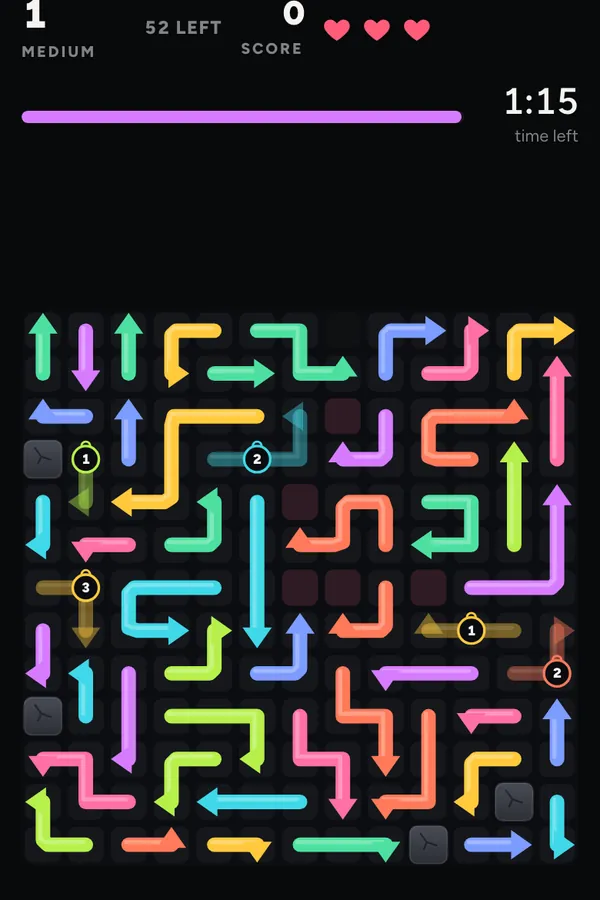
medium 13 × 13 · stones and locks

Bigger board, more stones, more locks and a tighter clock.

quick rules

outboundarrow puzzle game, clear the board

outbound is an arrow puzzle you play against the clock. The board is packed with bent arrows. Tap one and it slides off the board the way its head points, as long as nothing is in its path.

Every board has a solution, so the puzzle is spotting which arrows are free right now. Tapping an arrow that another arrow blocks costs a heart and two seconds, and locked arrows wait until a set number of others have left.

To read a board, follow an arrow's head to the edge. If something is in the way, that blocker has to go first, so ask the same of it, and keep going. The chain always ends at a free arrow, because boards are built by placing each arrow only along a line that is empty at that moment, so an arrow can only be blocked by later-placed ones. Clearing a free arrow can never block another.

Full rules and strategy for outbound
Rules, controls, scoring & tips

about the game

Playing outbound

An arrow puzzle against the clock. Stones shape the board, locked arrows wait their turn, and a clearing order is built into every generated board.

Controls

  • Touch or mouse: tap or click an arrow to send it out.
  • Keyboard: the arrow keys move a cursor over the board, Enter or Space taps, H gives a hint, U or Z undoes and R restarts.

Scoring

Each arrow scores its length times 10, a quarter more for every step of a combo of quick clears, and 1.5 times that if it was locked. A cleared board adds 20 points per second left and 150 per heart left. Stars: three for no wrong taps and 40 percent of the clock left, two for at most one wrong tap, one for any clear.

Tips

  • Look along each arrow's head to the edge of the board. If the line is empty it can leave, and clearing those first opens the arrows behind them.
  • Clear free arrows in quick streaks. A clear within 1.5 seconds of the last builds a combo, and from the third in a row each clear gives bonus time.
  • Let locked arrows wait. Their number counts down as other arrows leave, and tapping one early costs 2 seconds.
  • Sweep every arrow that is already free before you stop to think. Removing one never blocks another, and the combo multiplier grows by a quarter with each clear made within 1.5 seconds of the last. 40 four-cell arrows score 1,600 with no combo and 9,400 in one unbroken streak.
  • Spend a hint rather than guess. A hint costs no time, while a blocked tap costs a heart, 2 seconds and your whole combo.
A packed board of coloured arrows with numbered locks, hearts and a countdown timer.
Full rules and strategy for outbound Play today's outbound daily

questions

outbound questions

How do you solve an arrow puzzle in outbound?

Follow each arrow's head toward the edge of the board. Tap it when that path is clear, or remove its blockers first. Clearing a free arrow opens space for others. Clear them all before time runs out, and let numbered locks count down.

What changes between easy, medium and hard?

Easy is 10 by 10 with three hearts, three hints and undo. Medium is 13 by 13 with three hearts, two hints, undo and a tighter clock. Hard is 16 by 16 with two hearts, one hint, no undo, locks that wait for up to ten arrows and about a second per arrow.

What do hints and undo cost?

A hint costs no time. It pulses one arrow that can leave right now, picked at random from the free ones. Undo puts the last cleared arrow back and takes its points away, costs 3 seconds and resets your combo.

What are the grey stones for?

Stones are fixed and never move, but the generator never aims an arrow at one. They only shape the board, and the arrows that block each other are what make the order matter.

Can a board ever be impossible?

No. Boards are generated by placing arrows in reverse removal order, each along an empty line, and locks never ask for more exits than arrows placed after them. There is always a free arrow, and clearing a free arrow never closes another line. The generator is tested on 1,000 boards per difficulty.

How is the clock length decided?

It is a base of 8, 4 or 3 seconds plus the arrow count times 2.4, 1.4 or 1.1 seconds, scaled by a level factor of 1 minus 0.018 per level that stops falling at 0.65 on level 20. A medium level 1 board with 52 arrows gets 75 seconds. Each clear also gives a little time back, and the clock never rises above its start.

Are the endless levels random?

No. Each level is a fixed board for its difficulty, the same for every player, so restarting a failed level replays the same board. Stones, locks and arrow length reach full strength by about level 6, and only the clock tightens until level 20.

Does the combo have a cap?

No. Each clear within 1.5 seconds of the last adds a quarter to the multiplier, and a wrong tap, an undo or a longer pause resets it to zero. Tapping a locked arrow early costs time but does not reset it.

What happens when I run out of hearts or time?

The board ends with the arrows still on it, and you get no stars. Your points so far stay as the score, but the time and heart bonuses only come with a cleared board.

Can I challenge a friend to the same board?

After a win, challenge a friend shares a link that carries the board and your score. Your friend plays the exact same board and sees the score to beat.