bridge

Blocking them is the same move as winning.

Connect your two edges with an unbroken chain. Every tile you place is both a step forward and a wall in their way.

Solo or multiplayer?

tuned 7×7 · fair fight

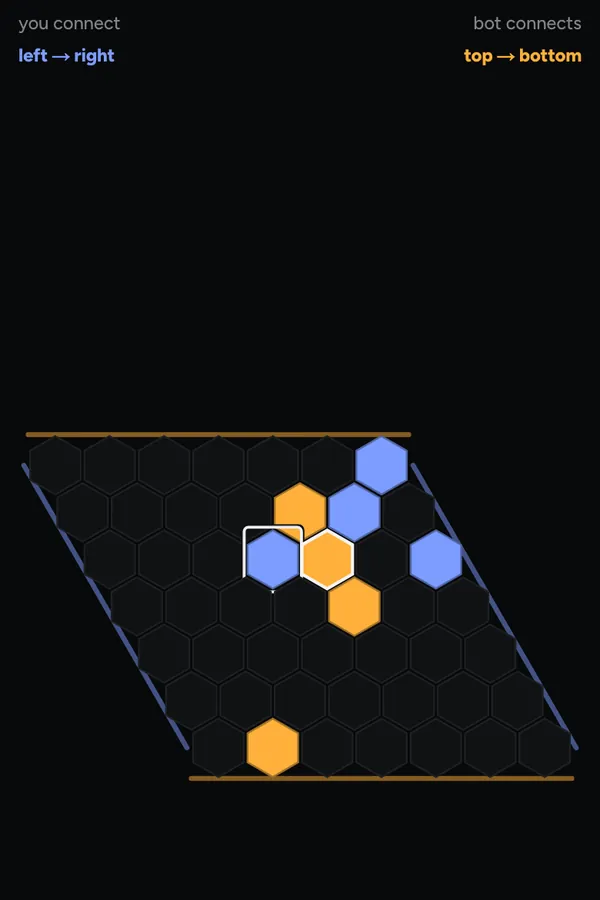
Bot takes the cell you wanted, which is also the one it needs.

quick rules

bridgehex connection board game vs a bot

Bridge is a connection game on a rhombus of hexagons. You own the left and right rails and the bot owns the top and bottom. Take turns placing one tile on any empty hex, and win by joining your two rails with a chain of touching tiles before the bot joins its own. Tiles are never removed or moved.

Every hex near the crossing of the two routes is wanted by both sides, so taking it builds your chain and bends theirs at once. You move first in solo. Loose is a 5 by 5 board against a bot that only follows its own tiles, while tuned (7 by 7) and ruthless (9 by 9) read both paths.

Full rules and strategy for bridge
Rules, controls, scoring & tips

about the game

Playing bridge

A free connection game on a hex grid. One rule, no draws, and depth that does not run out. No download, no account.

Controls

  • Touch: tap an empty hex to place your tile.
  • Mouse or pen: click an empty hex. Once placed, a tile cannot be moved or taken back.
  • Keyboard: Tab to the board, use the arrow keys to step one row or column, then Enter or Space to place. Home and End jump to the first and last hex in the row. Input is ignored while the bot is thinking.

Scoring

A win earns 100 points plus 4 for each empty hex when you connect, multiplied by 0.7 on loose, 1 on tuned or 1.4 on ruthless, and rounded. A loss earns zero. Time does not change the score. A tuned win that leaves 26 hexes empty scores 204.

Tips

  • Build with two-way links. Two tiles that share two empty neighbours cannot be cut, because if the bot takes one shared hex you take the other. A tile one step in from your rail is attached the same way.
  • When the bot plays one hex of a two-way link, answer with the other at once. Waiting lets it take both.
  • Check the bot's next step before extending your own chain. The hex that helps you most is often the one it needs, and taking it does both jobs.
Blue and orange tiles form competing paths across the hexagonal bridge board.
Full rules and strategy for bridge Play today's bridge daily

questions

bridge questions

Is bridge a Hex connection game?

Yes. bridge is a Hex board game where you take turns placing tiles on empty hexes. Join your two opposite rails before your opponent joins theirs. Tiles stay where they are placed, so every move can build your path and block another.

Can bridge end in a draw?

No. On a fully filled board exactly one player has an edge-to-edge connection, never both and never neither. The game's own test fills random boards at all three sizes and checks it every time, so there is no tiebreak and no draw screen.

What changes between the board sizes?

Loose uses a 5 by 5 board and a bot that plays beside its own tiles 70 percent of the time without reading yours. Tuned uses 7 by 7 and ruthless 9 by 9, and both score every empty hex by how it shortens the bot's path and yours. The repository's test finds the two pick the same moves, so ruthless is mostly the larger board. Win multipliers are 0.7, 1 and 1.4.

Who moves first, and does it matter?

You do in every solo game, and there is no swap rule. In the standard form of this game, Hex, the first player has a winning strategy with perfect play, so the opening is an advantage. That is a theoretical result and does not guarantee a win against the bot.

What is the highest score I can get?

A win scores 100 plus 4 for each empty hex, times 0.7, 1 or 1.4. Winning in the fewest possible tiles as the opener leaves 16, 36 or 64 hexes empty, which is 115 on loose, 244 on tuned and 498 on ruthless. A bot that blocks you will make real scores lower.

Does my score count if I lose?

A loss scores zero and still counts as a run in the totals this browser keeps. Only a win has a points total, so conceding a win to chase more empty hexes always costs more than it gains.

Can I play against a friend?

Choose Multiplayer to create a private room and share its invite link. Your friend joins from their browser. Ready up, then the host starts. Each player sees their own chain run left to right and the opponent's moves are mirrored to match. Room results are separate from the public solo leaderboards and need a connection.