How to play cat watch: a rope untangle puzzle
Updated
On this page
cat watch is a rope untangle puzzle played one move at a time. Songbirds and hawks sit in the sky above a tree branch, each tied by a rope to a numbered ring on the branch. The ropes cross. Untangle them and the songbirds fly free, but a tabby cat walks along the branch from the left, one ring per move, or one ring per two moves on easy.
Moving a rope
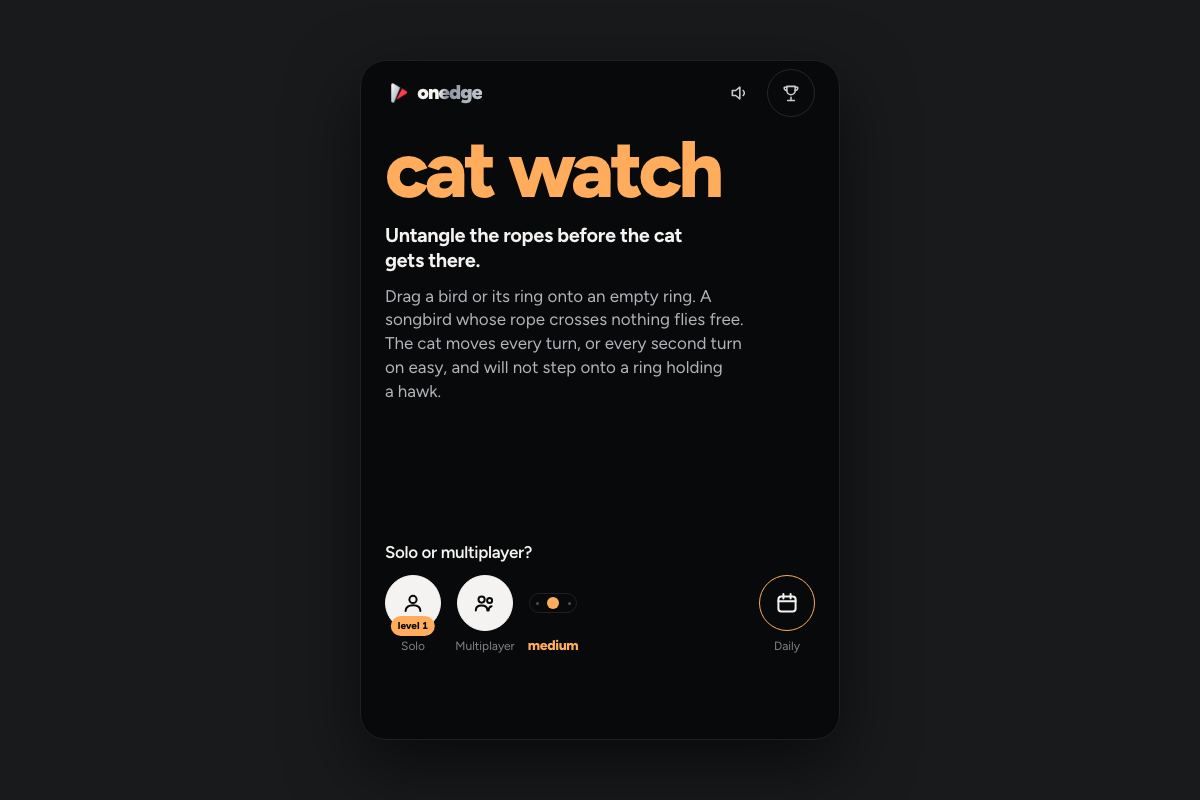 The start screen. The difficulty switch sets the cat’s speed, the bird and hawk counts and the undos, and each difficulty keeps its own level and stars in this browser.
- Touch or mouse: press a bird, its rope or its ring, drag it onto an empty ring and let go. Or tap a bird, then tap an empty ring.
- Keyboard: the rings are numbered on the branch. Press the number of a ring that holds a rope to pick it up, then the number of an empty ring to drop it. Left and right arrows move between rings, Enter or Space picks up or drops, Escape puts the rope back, Z undoes and R restarts. Number keys cover rings 1 to 9, and the biggest board has nine rings.
- Letting go anywhere else puts the rope back. That is not a move.
- Every drop onto an empty ring is one move, even when nothing is freed.
Reading the knots
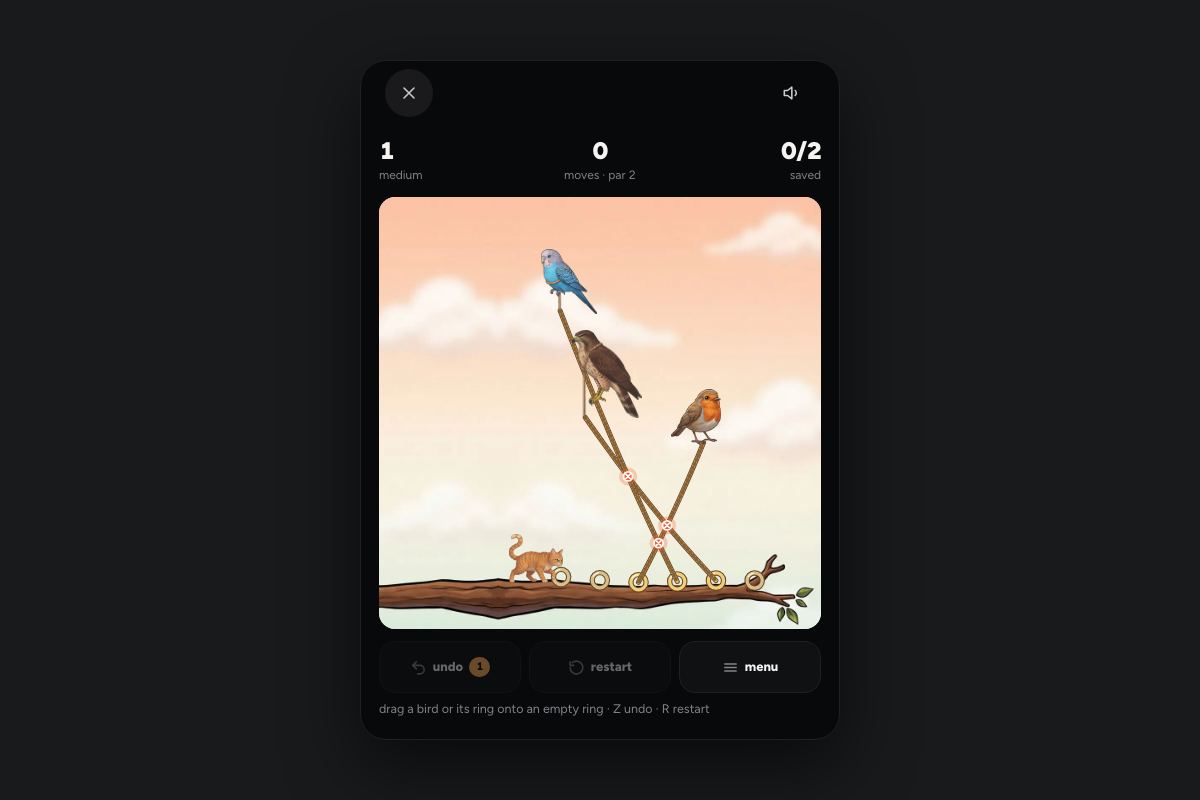 Level 1 on medium before the first move, par 2. Knot markers sit on every crossing. While you drag a rope, any other songbird whose rope would then cross nothing glows green, which is your preview of a rescue.
A songbird flies free the moment its rope crosses no other rope that is still tied. Hawk ropes count as ropes: a hawk never leaves, so its rope is a permanent crossing risk. A freed bird’s rope disappears, so freeing one bird can leave another clear, and that one flies as well in the same move. The game checks round after round until nothing more comes free. Two or more birds freed during one move show a combo.
Every starting board is built so that each songbird begins with at least one knot, so nothing is free on move zero.
The cat clock
The cat starts at the left end of the branch, one step before ring 1, and walks toward the nearest songbird that is still tied, measured in rings. Ties go to the lower ring. If it steps onto a ring that holds a tied songbird’s rope, that bird is caught. It catches any songbird on the ring it steps onto, not only the one it was heading for.
The arithmetic is simple. A songbird sitting untouched on ring k is caught:
- medium and hard: after your k-th move, because the cat steps once per move and needs k steps to reach ring k.
- easy: after your 2k-th move, because the cat only moves after every second move of yours.
So a songbird on ring 3 has to be freed or moved by your third move on medium, because the cat steps onto ring 3 right after it. On easy the same bird has until your sixth move. This assumes nothing blocks the cat. Songbirds never start on ring 1, so they always begin at least two rings from the cat.
Dropping a songbird’s rope on the ring the cat is standing on catches it instantly, unless that very move frees it. A songbird on the ring next to the cat shakes and shows a warning.
Hawks are walls, and sometimes a full stop
The cat never steps onto a ring that holds a hawk’s rope. When its way is blocked it looks for the nearest songbird in the other direction. If there is none there, it stays put and hisses. Because the cat starts at the left end, every songbird is on its right at the start, so a hawk rope on the ring in front of the cat stops it completely for as long as it stays there. It has somewhere else to go only if a tied songbird is on its other side.
That is a real trade. While the cat is stuck you can take extra moves without losing a bird, but every move still counts toward par. And a hawk’s rope is also a crossing to untangle, so sometimes the hawk has to move.
A solved board, move by move
Easy level 1 is the same for everyone. It has two songbirds, one hawk and six rings, with the songbirds on rings 5 and 4 and the hawk on ring 6. The game’s solver finds a two-move solution:
- Move the ring-5 songbird’s rope to ring 1. Its rope now crosses nothing, so it flies free. It is move one, and on easy the cat rests.
- Move the hawk’s rope to ring 1, which is empty again because the freed bird’s rope is gone. The ring-4 songbird is now clear and flies free.
Both birds are saved in two moves, equal to par, so three stars. The cat never moves at all. On bigger boards the same ideas apply: look for the bird that is one rope away from free, and ask what moving a hawk does to the others.
Par, stars and undo
The generator keeps a board only if a breadth-first solver finds a way to save every songbird under the exact rules, with the cat moving as it would in play. The fewest moves is par.
- Save every bird in par moves or fewer: three stars.
- Save every bird in more moves: two stars.
- Save at least one bird: one star.
- Save none: no stars, and the same branch again.
A board finished with at least one star unlocks the next level. Endless levels go on without end, but the size stops growing: easy never goes beyond three songbirds, one hawk and two spare rings, medium reaches four songbirds with two hawks from level 8, and hard reaches five songbirds with three hawks from level 10.
An undo takes back your last move and the cat’s step after it, and the move leaves your count, so a spent undo does not cost par. Easy has three undos, medium one and hard none, per board. R restarts the board without limit and does not refill them.
What each difficulty changes
| easy | medium | hard | |
|---|---|---|---|
| Cat moves | every second move | every move | every move |
| Songbirds | 2, then 3 from level 4 | 2, 3 from level 3, 4 from level 8 | 3, 4 from level 4, 5 from level 10 |
| Hawks | 1 | 1, then 2 from level 5 | 2, then 3 from level 6 |
| Empty rings at the start | 3, then 2 from level 6 | 3, then 2 from level 4 | 2, then 1 from level 6 |
| Undos | 3 | 1 | none |
| Par range | 2 to 6 | 2 to 8 | 4 to 9 |
The daily branch
Every UTC day each difficulty has one branch, the same for everyone. It always uses the size of endless level 7: easy has 3 songbirds, 1 hawk and 6 rings, medium 3 songbirds, 2 hawks and 7 rings, and hard 4 songbirds, 3 hawks and 8 rings. Par runs from 3 to 6 on easy, 4 to 8 on medium and 5 to 9 on hard.
The daily score is 100 per songbird saved plus 10 for every move under a limit of par plus 6. A full save at par is 360 on easy and medium and 460 on hard. Your first finish on each difficulty is the scored one and the attempt is used up when the last bird is freed or caught, so quitting, R or a reload does not spend it. Later finishes are practice, and the result says so.
The server range-checks daily and endless results rather than replaying them, so treat the tables as lightly checked.
Mistakes the mechanics explain
- Starting with the knots. The cat clock is the real limit. Count rings to the nearest tied songbird first.
- Parking a bird on a far ring and forgetting it still crosses things. A far ring buys time but does not free a bird.
- Leaving a songbird on the cat’s route. The cat catches any tied songbird on a ring it steps onto, not just its target, so a bird parked close to the cat is lost even if another bird was the nearest.
- Burning undos early on medium. There is only one, and it takes the move back off your count, so keep it for the move that gets a bird caught.
If you like this
leash-park is the closest relative: drag stakes until a leash runs clear, and a pup that waits too long gets grumpy and breaks loose. cornered also gives an enemy a step for each of yours, so you plan around where it will be next. outbound is another puzzle where the whole challenge is finding the right order.
Written by the developer from the game's own code. Spot a mistake? hello@onedge.fun