How to play graze: dodge bullets and score close passes
Updated
On this page
graze is a bullet hell survival game you play in the browser. Shots pour in from every edge of the screen, and one touch ends the run. The twist is the score: hiding pays almost nothing, and nearly all the points come from letting a shot pass as close to you as you dare.
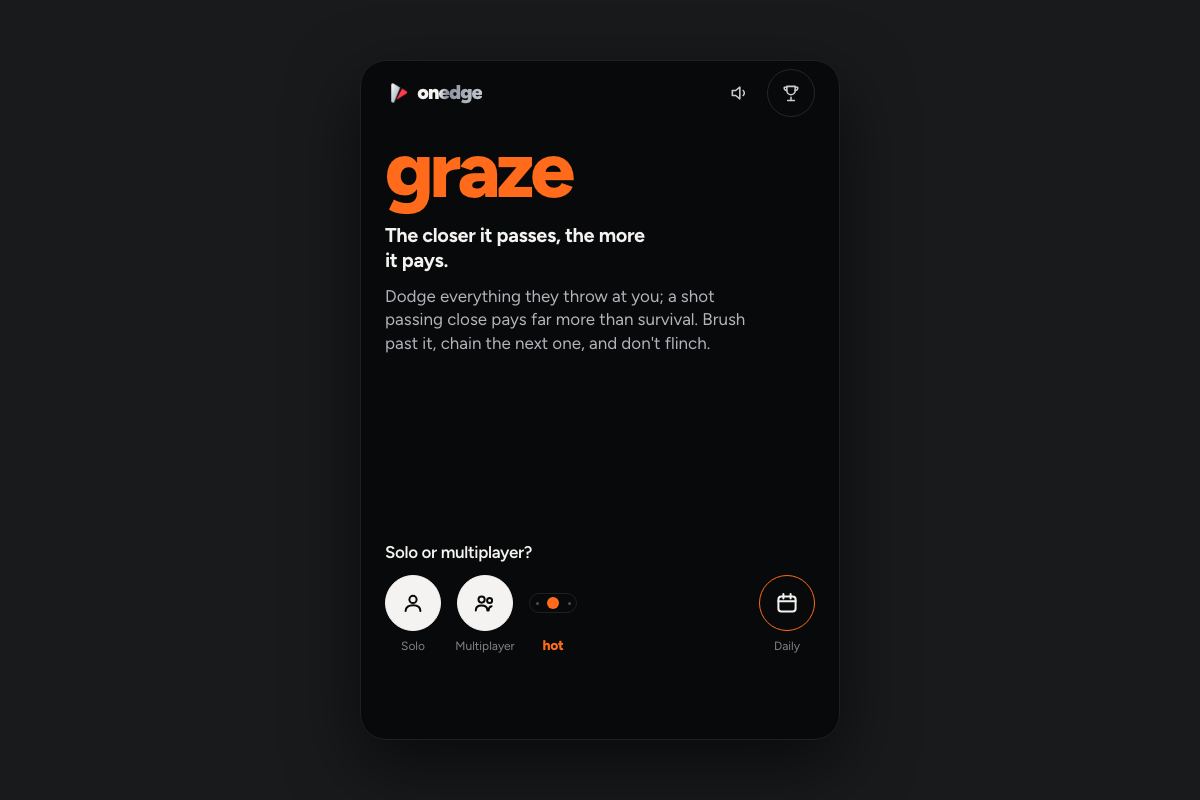 The start screen. The selector next to Solo and Multiplayer picks calm, hot or redline, and Daily is today’s seeded fire.
There are no lives, no shields and no bombs. The run ends at the first hit.
Controls, and the lag you have to respect
- Mouse: the ship follows your pointer.
- Touch: drag anywhere in the arena. The ship moves 1.35 times as far as your finger, so your thumb never has to sit on top of it.
- Keyboard: arrow keys or WASD, moving the target at 300 arena units a second.
The ship does not teleport to your pointer. It closes the gap with a smoothing curve that covers half the distance in about 0.08 seconds and nearly all of it in a second. That lag matters: the hit area belongs to the ship, not to your cursor, so a fast flick that crosses a shot’s path can still be caught by the ship a moment later. Small, early movements are safer than late, big ones.
What actually kills you, and what pays
Everything is measured in arena units, where the short side of the arena is 420 units wide and the ship has a radius of 5.5.
- A shot kills you when its centre gets closer than its own radius plus 72 percent of the ship radius. For an ordinary shot (radius 5) that is 5 + 3.96 = 8.96 units. The glowing ship you see is bigger than the part that can die.
- Around that death distance sits a graze ring 24 units thick, drawn as the dashed circle in the screenshot below. A shot that enters the ring and leaves again without touching you is a graze.
- The payout is decided by the closest the shot came while inside the ring, and it is paid when the shot leaves the ring. A shot that kills you while inside the ring pays nothing.
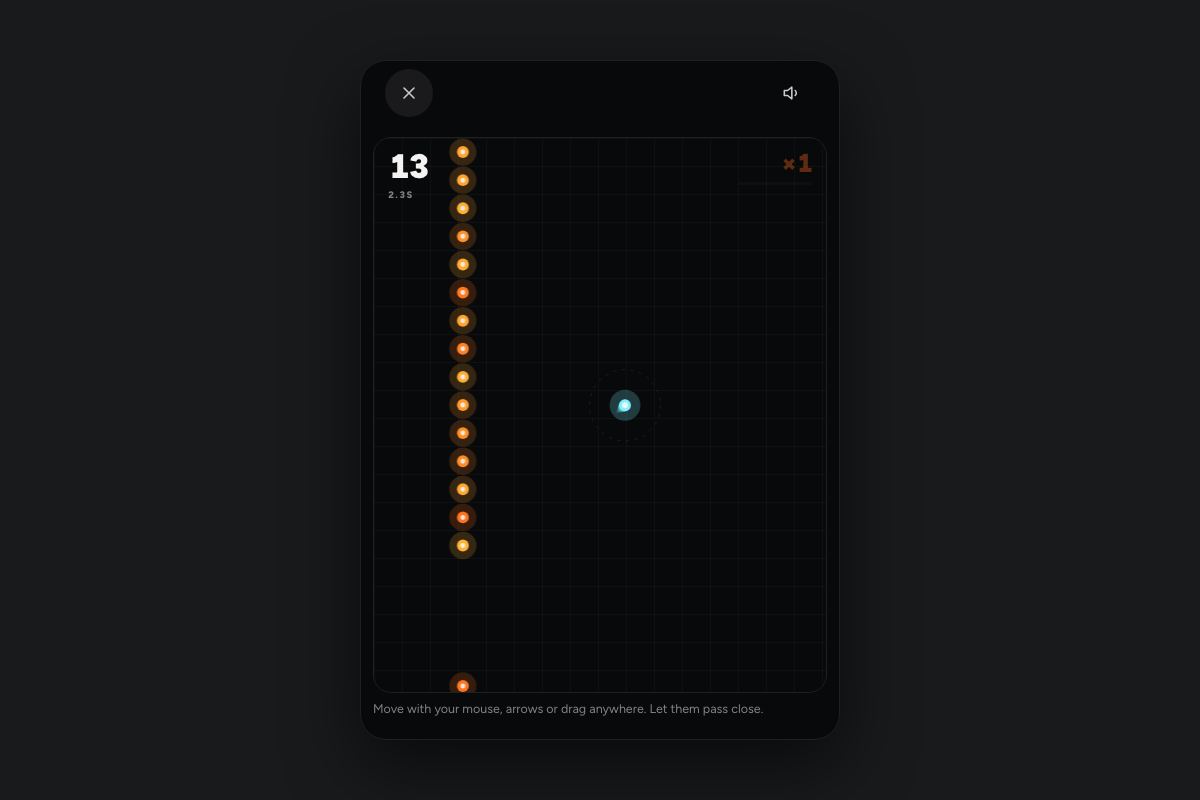 The dashed ring around the ship is the graze zone. The vertical line of shots is a wall with a four-cell gap near the bottom. None has reached the ring yet, so the chain still reads x1.
The payout curve, with numbers
A graze is worth 8 + 72 x closeness squared, where closeness runs from 0 at the outer edge of the ring to 1 at the death distance. That number is then multiplied by your current chain and the level multiplier. On hot with a chain of 1:
| Closeness | Points |
|---|---|
| 0 (edge of the ring) | 8 |
| 0.25 | 13 |
| 0.5 (halfway in) | 26 |
| 0.75 | 49 |
| 0.9 | 66 |
| 1 (a hair from dying) | 80 |
Halfway into the ring pays about a third of the maximum. The last quarter of the ring pays more than everything before it, which is why the game rewards nerve rather than care.
The chain, and one worked run
Every graze adds 1 to the chain, up to x40. The payout uses the chain you had before that graze, so the first graze is always paid at x1. If 1.7 seconds go by without a graze, the chain drops to x1.
Take five grazes in a row, each at closeness 0.6 on hot. Each is worth 8 + 72 x 0.36 = 33.92 before the chain, so they pay 34, 68, 102, 136 and 170, a total of 510. The same five at chain 1 each would pay 170. Meanwhile ten seconds of survival at 6 points a second is only 60.
Scale that to the top: a closeness-1 graze at x40 on hot is 3,200 points, and 4,800 on redline. Surviving at 6 a second would need almost nine minutes to match a single one. That is the whole design: keep the chain alive, then cash in close.
The fire, in the order it arrives
Every 20 seconds a banner announces the next phase. Underneath, the ramp is continuous.
- Shot speed starts at 118 units a second on hot and gains 1.3 every second for the first 120 seconds, reaching 274. Each pattern scales that: aimed shots run at 1.05 times, rings at 0.8, walls at 0.72, spirals at 0.75 and sweeps at 1.1.
- Attack rate: the gap between attacks begins at 1.35 seconds and shrinks by 0.012 each second down to a floor of 0.34 seconds, which it reaches at about 84 seconds. That is roughly 3 attacks a second on hot, once things have settled.
Which pattern appears is drawn from the seeded random generator:
- Aimed bursts and walls from the start. The pool is two parts aimed to one part wall. An aimed burst fires from a random edge point at where you are standing at that instant. It starts as a single shot and gains one shot every 18 seconds, to a maximum of four. Neighbouring shots in a burst are 0.17 radians apart, about 17 units at 100 units of distance and 34 at 200.
- Rings after 10 seconds. A ring of 11 shots bursts outward from a point on the top or bottom edge, gaining one shot every 10 seconds, up to 20.
- Spirals after 22 seconds. An emitter sits inside the arena, 12 percent in from a side and 10 percent in from the top or bottom, and fires two opposite shots every 0.085 seconds for 2.4 seconds while turning. That is about 29 firings and 58 shots.
- Sweeps after 34 seconds. An emitter on an edge picks the direction of your ship at that moment, then fires about 19 shots over 1.1 seconds across an arc of 0.6 radians either side. The arc closes toward one end, so shots crowd together there and are widest apart at the start.
Once all five patterns are available the pool becomes three aimed, one wall, one ring, one spiral and one sweep.
Reading each attack
Aimed shots head for where you were, in a straight line. Standing still on that line gets you hit. A steady sidestep sends the shot past you, and the smaller the sidestep, the closer the pass. Against a four-shot fan at 200 units distance the lanes are 34 units apart, with only about 16 units of safe room for the ship centre between two shots.
Walls are a line of shots on 26-unit spacing with a gap. The gap is 4 cells wide for the first 40 seconds, 3 from 40 seconds and 2 from 80 seconds. Stand dead centre in a two-cell gap and you are 39 units from each edge shot, outside the graze ring entirely, so you are safe and earn nothing. Lean about 5.5 units toward one side and the edge shots enter the ring; lean past about 29.5 and you die. That 24-unit strip is where the wall pays.
Rings are easy to thread because the spacing between shots grows with distance. With 20 shots, neighbours are about 31 units apart at 100 units from the centre, so fly toward the middle of a gap instead of away from the burst.
Spirals only last 2.4 seconds and start near a corner, so the middle of the arena gets the most warning. Sweeps commit to where you were when they spawned, so reposition early and use the widest part of the arc.
The three levels are not just easier and harder
| Level | Speed | Attack rate | Score multiplier |
|---|---|---|---|
| calm | 0.78 | 0.72 | 0.7 |
| hot | 1 | 1 | 1 |
| redline | 1.24 | 1.32 | 1.5 |
Because the chain window is a fixed 1.7 seconds, the attack rate changes how hard the chain is to hold. On calm the late-game floor is one attack about every 0.47 seconds; on redline it is about every 0.26. Fewer shots mean fewer chances to refresh the window, so calm is more forgiving to survive but not necessarily easier to chain. Redline gives you the most shots to graze and also the least time to think.
Each mode and level combination keeps its own personal best on your device. Your endless best and your daily best are separate.
A practice routine
- Calm, first minute: ignore the score. Watch the result screen’s closest figure, which is the gap in units between you and the closest shot (0 means touching the death distance). Aim to see it get below 5.
- Calm to hot: keep the ship small-moving. Work on holding a chain of x5 for ten seconds before attempting anything bigger.
- Hot, walls: deliberately take the wall gap off-centre so the edge shots enter the ring.
- Redline: only once hot runs reach the later phases. The speed ramp matters more than the multiplier.
Today’s fire, challenge links and rooms
Today’s fire is the daily mode. The seed is built from the UTC day number and the level id, so each level has its own schedule that resets at midnight UTC. The seed drives the random generator that picks patterns and spawn points. Aimed shots and sweeps still aim at your ship, so their paths depend on how you move. The arena takes the shape of your window (its short side is always 420 units), so spawn positions scale with the shape of your screen. A wall has one shot per 26-unit cell along the screen edge, and each shot draws a random number, so screens of different shapes drift out of step after the first wall. Two windows with the same shape see the same fire.
Your first daily start on a level each day is marked as the daily run, even if you quit it. Later starts are labelled daily practice and are not submitted. That marker is stored in this browser, and the score service keeps only the first valid daily result for each anonymous browser identity and level. It does not enforce one attempt per person across devices.
challenge a friend appears after a run. It shares a link with that run’s seed, level and score. Whoever opens it should pick the level the link names: the seed is only used on that level. They then play the same fire and see the score to beat.
Multiplayer offers live rooms of up to 8 players with a 90 second round, plus challenge links. The server checks room scores for plausibility, not by replaying them.
The result screen also shows your time, the phase tape, grazes, best chain and closest pass.
How it is built
The simulation runs on a fixed step of 1/120 of a second regardless of your refresh rate, so one seed plays the same on a 60 Hz phone and a 144 Hz monitor with the same window shape. Every spawn decision comes from the seeded generator. The payout is squared on purpose, so the last units of the ring dominate. The server only accepts a score if it falls between the survival points plus 8 per graze and the survival points plus 80 per graze times your best chain, multiplied by the level. The arena caps at 360 shots on screen at once.
Related games
deadband rewards the same restraint: small, early moves beat big ones. updraft is a one-button cave flyer where steady input keeps you alive.
Written by the developer from the game's own code. Spot a mistake? hello@onedge.fun