Why almost nobody stops in time (and why some people stop too early)
Updated
On this page
An earlier game on this site, now retired, opened with the line almost nobody stops in time. I built a lot of these games around that idea. In updraft you hold to climb and let go to fall, and every run is a question of how far to push it. In graze the points are in the close calls. In closure the last line is the one that costs you.
Research on risk taking gives a less tidy picture than that line suggests. Balloon tasks, game-show decisions and gambling experiments study different choices. Their findings are useful comparisons, but they are not measurements of people playing onedge.
The connection to these games is an interpretation, not a result established by those studies.
The balloon that makes people cautious
The best-known lab test for “pushing your luck” is the Balloon Analogue Risk Task, or BART, created by Carl Lejuez and colleagues in 2002.
It works like this. You see a balloon on screen. Every pump adds a little money to a temporary bank. At any point you can cash out and keep it. But every balloon has a hidden popping point, and if it pops, you lose everything from that balloon.
The original study evaluated the task as a measure of risk taking and compared it with other risk measures. The number of pumps has to be read against the experiment’s balloon settings, rewards and participants. It is not a general score for how brave or careful a person should be.
There is also a limit to the comparison: BART lets you cash out, while updraft ends on a collision and has no bank button. Its short holds are about controlling momentum, not choosing when to collect a payout.
What changes after a loss
Choices can shift after recent outcomes. One example comes from the TV game show Deal or No Deal. In 2008, economists Thierry Post, Martijn van den Assem, Guido Baltussen and Richard Thaler studied how contestants made real, high-stakes choices on the show.
They found that contestants became less careful after a bad run, when the big prizes they’d hoped for were knocked out. Some became real risk-takers, turning down offers that were worth more than the average of what was left. The authors call this the break-even effect. After a loss, people want to get back to where they started, and they’ll take bigger risks to do it.
Contestants also got less careful after unusually good luck. This is sometimes called the house-money effect. When a win feels like a bonus, it feels cheaper to gamble.
These game-show results suggest that recent outcomes can shift risk taking. That offers a way to think about the urge to recover a lost game; it does not prove what motivates a particular closure move.
Near misses feel bad but pull you back in
The third piece is the near miss.
In a well-known 2009 study, Luke Clark and colleagues had people play a simple slot-machine game. Near misses, where the reel stopped just next to a win, felt worse than clear misses. But they made people want to keep playing more than clear misses did. Brain scans showed near misses lighting up some of the same reward areas as real wins.
One detail really matters for games: the effect showed up when players felt in control of the choice. When the computer made the choice for them, near misses didn’t have the same pull.
That finding comes from a gambling experiment. A close pass in a skill game is a different event, so the same psychological effect should not be assumed.
graze makes close passes an explicit reward. Surviving earns a small score, and shots that pass close pay much more. There is no money involved, and the run lasts until the first hit. That explains the game’s reward system; it does not establish why a particular player wants another run.
The one game here with a real cash-out
I said above that updraft has no bank button. hustler does, and it is the closest thing here to a balloon task, with numbers you can check in its code.
You start a night with 100 coins and play ten hands. Each hand stakes about a fifth of your bank, rounded to the nearest 5 with a minimum of 10, so the first stake is 20. Find the ball and the pot doubles to 40 (call the hustler’s palming trick correctly and it triples). Then you choose: bank the pot, or ride it. A ride keeps the whole pot on the table for another, harder shuffle on the same hand, up to three rides. Lose a ride and the pot is gone, though the rest of your bank is untouched.
For a cup-only strategy, the break-even point is simple. Banking keeps the pot. Riding returns twice the pot with probability p and nothing otherwise, so it improves the average payout only when 2p is greater than 1. A correct cheat call pays triple instead: if p is your chance of a correct cup pick and q is your chance of a correct cheat call, counting those as separate outcomes, the comparison becomes 2p + 3q versus 1. These comparisons assume the payout is below the game’s 99,999-coin cap, as it is for the example below. That is why tracking his sleeve changes the decision.
Picking a cup blindly succeeds at most 1 time in 3 with three cups or 1 in 4 with four; when the ball is palmed, no cup can win. A blind cup-only ride therefore loses expected value. These are fictional game coins, with no purchase or cash prize.
Riding also makes the next shuffle harder, because each ride counts as two extra hands of difficulty. For the medium level at level 1, hand 3, the game’s own pace function gives:
| Rides taken | Cups | Swaps | Seconds per swap | Chance he cheats |
|---|---|---|---|---|
| 0 | 3 | 6 | 0.44 | 37% |
| 1 | 3 | 8 | 0.39 | 45% |
| 2 | 4 | 11 | 0.34 | 53% |
| 3 | 4 | 13 | 0.29 | 61% |
A sequence of four correct cup picks from a 20 coin stake pays 40, 80, 160 and then 320. Ignoring palming, blind picks across the cup counts in the table would succeed with probability 1/3 x 1/3 x 1/4 x 1/4, about 0.7 percent. Palming makes a blind cup-only strategy worse; cheat calls have a different payout, so this is an illustration rather than the game’s overall win rate. If a hypothetical player has conditional success rates of 70 percent on each of the first two shuffles and 60 percent on each of the last two, the chance of four cup wins is about 18 percent. None of those rates was measured from visitors. The practical question is whether your tracking stays reliable as the shuffle gets harder.
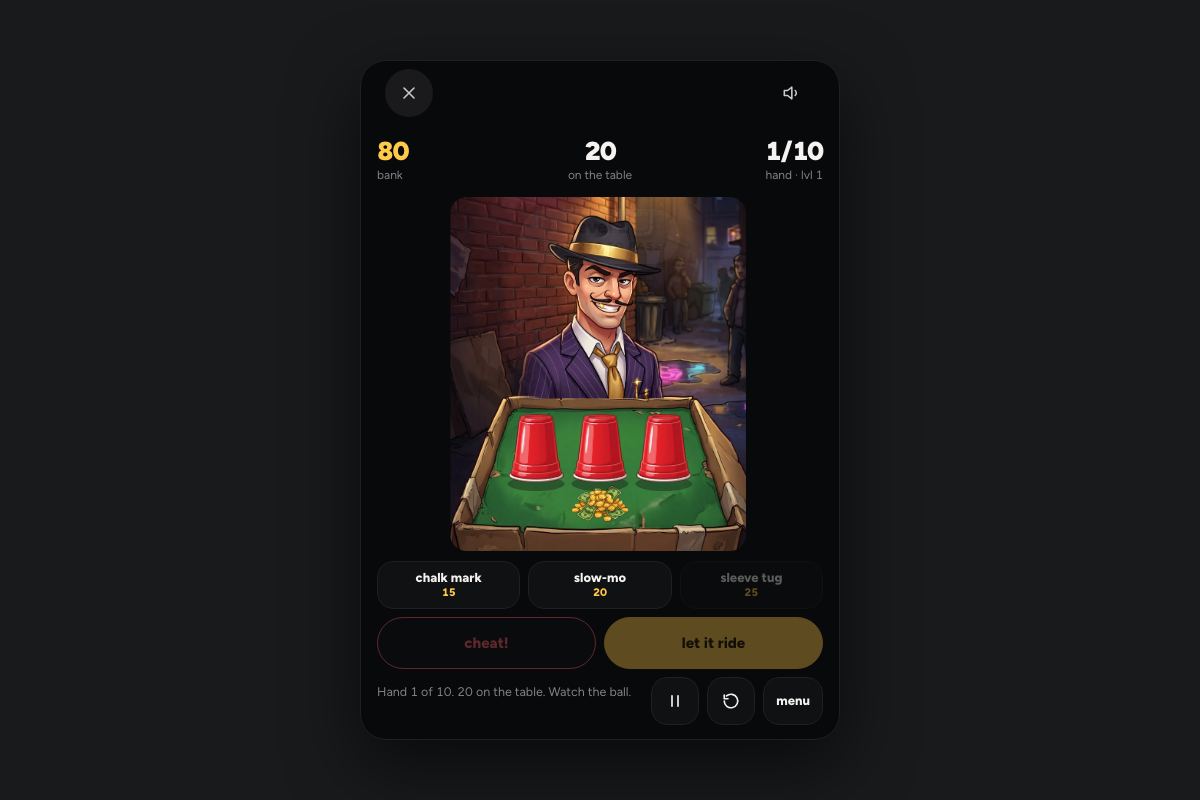 Hustler’s cheat and let it ride controls. Cup wins pay double; correctly calling a palmed ball pays triple. The expected payout depends on both.
The other way to not stop: overcorrecting
Pushing too far isn’t the only way to fail at stopping. The other one is not being able to stop adjusting.
You overshoot, so you correct. You overshoot the correction, so you correct again. tint is built around this: fixing a colour costs more than getting it right the first time, so every extra tweak has a price. deadband does the same with a drifting dot you have to keep inside a shrinking band while the system pushes back. Chasing it too hard is usually what knocks it out of the band.
That is an analogy with chasing a loss, rather than evidence that overcorrecting and the break-even effect are the same process. In these games the immediate explanation is mechanical: extra thrust changes momentum, and extra colour uses the room left in the beaker.
So when should you stop?
A few habits that help, in these games and outside them:
- Pick a practice focus before you start. Try shorter holds in updraft or smaller corrections in tint. Neither game offers a BART-style cash-out decision.
- Notice what just happened. If a loss or close call makes you want another try, pause long enough to choose what you will change. A feeling is not a prediction of the next result.
- Make smaller corrections. In deadband and tint, a small nudge and a pause usually beats a big correction.
- Keep the comparison in perspective. A balloon experiment is not a diagnosis of your play. Use the game’s own feedback to decide whether your next input was useful.
None of these games involve money, and they’re meant to be a safe place to feel that pull and practise noticing it. If you want to test yourself, start with graze or updraft. See whether your second run goes further than your first, and whether that was a good idea.
Sources
- Lejuez, C. W., et al. (2002). Evaluation of a behavioral measure of risk taking: the Balloon Analogue Risk Task (BART). Journal of Experimental Psychology: Applied, 8, 75–84.
- Post, T., van den Assem, M. J., Baltussen, G., & Thaler, R. H. (2008). Deal or No Deal? Decision making under risk in a large-payoff game show. American Economic Review, 98(1), 38–71.
- Clark, L., Lawrence, A. J., Astley-Jones, F., & Gray, N. (2009). Gambling near-misses enhance motivation to gamble and recruit win-related brain circuitry. Neuron, 61, 481–490.