How graze scores near misses: the distances, the chain and the numbers behind them
Updated
On this page
In graze surviving earns points, and close near misses add much larger rewards. The how-to-play guide covers the rules in plain language. This post gives the exact distances, formulas and timings, and what they imply when you decide how close to cut it.
Every number comes from the game’s configuration and simulation code, and the worked examples were computed by running it.
What counts as a graze
The arena is measured in units, scaled so the shorter side of the screen is 420 units. Your ship has a radius of 5.5 units, but the part that can be hit is smaller: the hitbox is 72% of that, 3.96 units. A standard shot has a radius of 5.
A shot kills you when the distance between its centre and yours drops below the sum of the two radii: 5 + 3.96 = 8.96 units. The wall uses shots of radius 5.5 and rings, spirals and sweeps use 4.5, so the kill distance shifts slightly by pattern.
The graze ring is a band of 24 units outside that kill distance. A standard shot enters it when its centre comes within 8.96 + 24 = 32.96 units of you, and from then on the game records its smallest distance to you.
Two details matter:
- Points arrive when the shot leaves the ring, not when it enters. A shot that hits you never also grazes you, and a shot still inside the ring when you die scores nothing.
- Each shot scores once. If several shots leave the ring in the same step, they are scored one after another, and each raises the chain for the next.
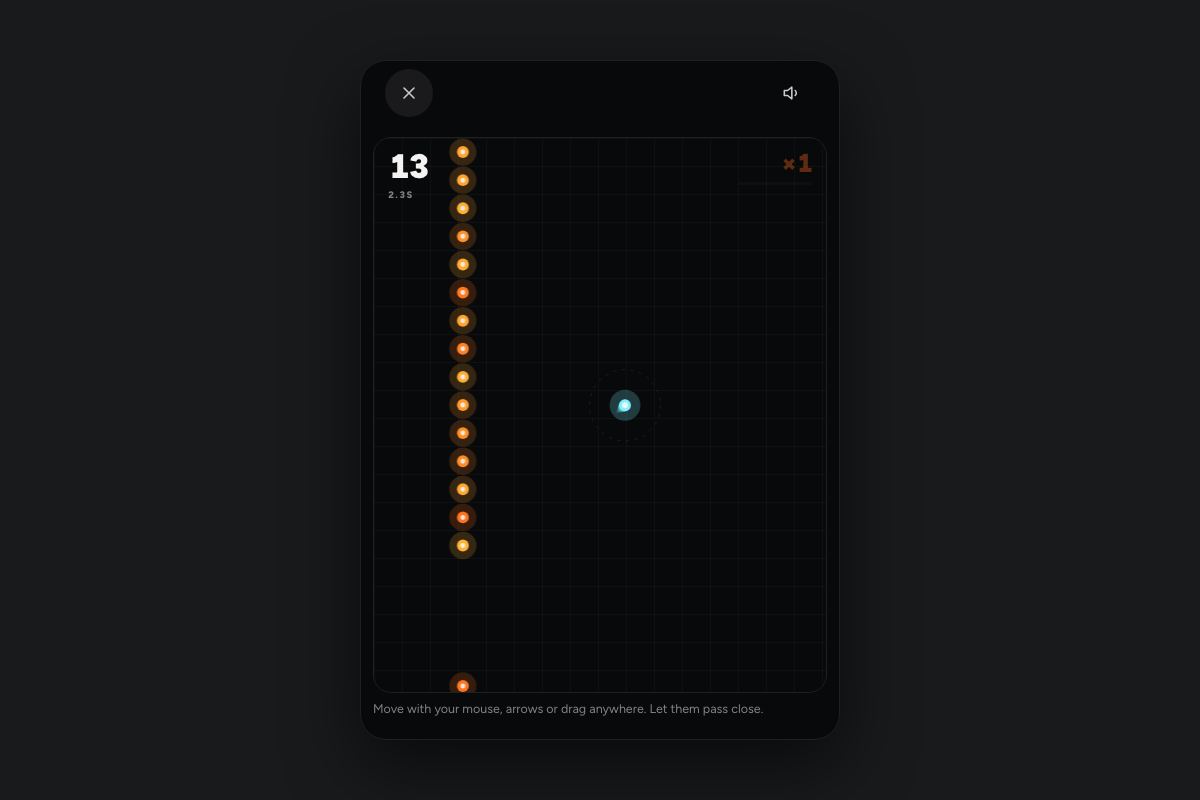 The dashed ring around the ship is the graze zone. A shot that passes inside it scores, and the closer it passes the more it pays.
How closeness is computed
The gap is the shot’s closest centre distance minus the kill distance. A gap of 0 means it came within a hair of killing you; a gap of 24 means it only just touched the ring. Closeness is:
closeness = 1 - gap / 24
It runs from 0 at the outer edge to 1 at zero gap. Because the kill distance is subtracted first, the same closeness means the same clearance whatever the shot’s size.
The points formula
Each graze scores:
points = round((8 + 72 × closeness²) × chain × level multiplier)
Closeness is squared, so the bonus grows slowly across the outer half of the ring and quickly across the inner part. A test confirms it: the bonus at closeness 1.0 is nine times the bonus at one third (72 versus 8).
Worked examples on hot (multiplier 1) at chain 1:
| Gap to a lethal hit | Closeness | Points |
|---|---|---|
| 24 units (edge of ring) | 0.00 | 8 |
| 18 units | 0.25 | 13 |
| 12 units | 0.50 | 26 |
| 5.28 units | 0.78 | 52 |
| 0 units | 1.00 | 80 |
A constant called CLOSE_GRAZE is set to 0.78, a gap of about 5.3 units. It does not change the score. Above it, a graze counts as close for feedback only: a bigger popup, more particles, an extra tone and a short vibration.
The chain
Every graze adds 1 to the chain, up to 40. The chain starts at 1, and a graze is scored with the value from before it increments: your first graze is multiplied by 1, your second by 2, your tenth by 10. The x number on screen is what your next graze will be multiplied by.
Each graze resets a 1.7 second timer. If 1.7 seconds pass with no graze, the chain drops to 1. Reaching the cap takes 39 grazes, after which every graze is multiplied by 40. The multiplier covers the whole formula including the base 8, so even the loosest graze is worth 8 × chain.
| Chain | Loose graze (0.25) | Close graze (0.78) | Closeness 1.0 |
|---|---|---|---|
| 1 | 13 | 52 | 80 |
| 5 | 63 | 259 | 400 |
| 10 | 125 | 518 | 800 |
| 40 | 500 | 2,072 | 3,200 |
Survival points and levels
Staying alive pays 6 points per second on hot, counted only while the run is live, not during the 1.6 second ready period. One minute of perfect safety is 360 points.
Each level has a multiplier applied to both survival and grazes: calm 0.7, hot 1, redline 1.5. Survival is therefore 4.2, 6 and 9 points per second. Since the multiplier hits both sources equally, the trade between surviving and grazing is the same everywhere: a close graze at chain 5 is worth about 43 seconds of survival on all three levels. What changes between levels is the fire, not the balance of the scoring.
How the fire ramps up
Everything that gets harder is a function of elapsed time, counted from the end of the ready period.
- Spawn interval. The first spawn comes 1.2 seconds in. The gap between spawns then starts at 1.35 seconds, shrinks by 0.012 seconds per second survived and stops at a floor of 0.34 seconds, reached at about 84 seconds. The level’s density divides it: 0.72 on calm, 1 on hot, 1.32 on redline.
- Shot speed. Base speed is 118 units per second plus 1.3 per second survived, capped at 120 seconds (274 on hot), then multiplied by the level speed of 0.78, 1 or 1.24 and by a per-pattern factor: aimed 1.05, rings 0.8, walls 0.72, spirals 0.75, sweeps 1.1.
- Pattern unlocks. The pool starts with aimed shots (listed twice) and walls. Rings join after 10 seconds, spirals after 22, and sweeps after 34, which also adds a third aimed entry.
- Pattern growth. Aimed volleys grow from 1 shot to 4, one more every 18 seconds. Rings start at 10 shots and gain one every 10 seconds, up to 20. Walls start with a 4-cell gap and narrow by one cell every 40 seconds, to a minimum of 2.
Phases tick over every 20 seconds and the game announces each one, but the phase number changes no rule. The ramp is continuous.
| Time | Spawn gap (hot) | Base speed (hot) |
|---|---|---|
| 0 s | 1.35 s | 118 |
| 34 s | 0.94 s | 162 |
| 60 s | 0.63 s | 196 |
| 84 s | 0.34 s | 227 |
The three levels at the 60 second mark
The level multipliers change speed and density as well as score. At 60 seconds the base speed is 118 + 1.3 x 60 = 196 units per second, and the spawn gap before the level’s density is 1.35 - 0.012 x 60 = 0.63 seconds:
| Level | Shot speed (before pattern factor) | Spawn gap | Spawn gap floor | Survival pay |
|---|---|---|---|---|
| calm | 196 x 0.78 = 153 | 0.63 / 0.72 = 0.88 s | 0.47 s | 4.2 per second |
| hot | 196 | 0.63 s | 0.34 s | 6 per second |
| redline | 196 x 1.24 = 243 | 0.63 / 1.32 = 0.48 s | 0.26 s | 9 per second |
At most 360 shots can be alive at once. Calm is therefore not just a lower multiplier: its fire is about 22 percent slower and about 28 percent sparser than hot’s, which is why it is the level to learn the chain on.
What the numbers imply
These follow from the formulas on hot, where survival is 6 points per second.
Chain length decides what a graze is worth in seconds. A graze at closeness 0.78 beats 10 seconds of survival from chain 2, 30 seconds from chain 4, 60 seconds from chain 7 and 120 seconds from chain 14.
Sloppy grazes pay once the chain is up. A graze at closeness 0 beats 10 seconds of survival at chain 8 and 30 seconds at chain 23.
Keeping the chain alive can beat chasing the closest pass. Ten close grazes in one chain score 2,849 points. The same ten, spaced more than 1.7 seconds apart so the chain resets each time, score 520. Ten loose grazes (0.25) in one chain score 690, more than ten isolated close ones. At five grazes the order flips: five chained loose grazes score 189, five isolated close ones 260.
A long chain is worth protecting. At chain 40 a single close graze is 2,072 points, about 345 seconds of survival on hot. One hit ends the run and takes the multiplier with it.
Why the refresh rate does not change the game
The simulation advances in fixed steps of 1/120 second. A display drawing 60 or 144 times a second just runs more or fewer steps per frame, and contact and closeness are checked on every step. A test runs one seed and one input at 60 Hz and 144 Hz and checks that the shots match byte for byte at 30 seconds.
The same determinism powers the daily run. Its seed is a hash of the UTC day number and the level, so everyone on a level gets the same fire schedule. The arena takes the shape of your window, so windows of different shapes can drift apart after the first wall. Aimed shots also point at your ship when they spawn, so the path you fly still matters.