How to play crooked hustler: follow the cups and catch a cheat
Updated
On this page
crooked hustler is a shell game with cups and a hidden ball, played in the browser. A street hustler in a pinstripe suit shows you a ball, covers it with a red cup and shuffles. Your job is to say where it went. His job is to make sure it is not where you think.
There is no real money in it. The bank is a score that starts at 100 every night, and the game keeps working if your connection drops after the page has loaded.
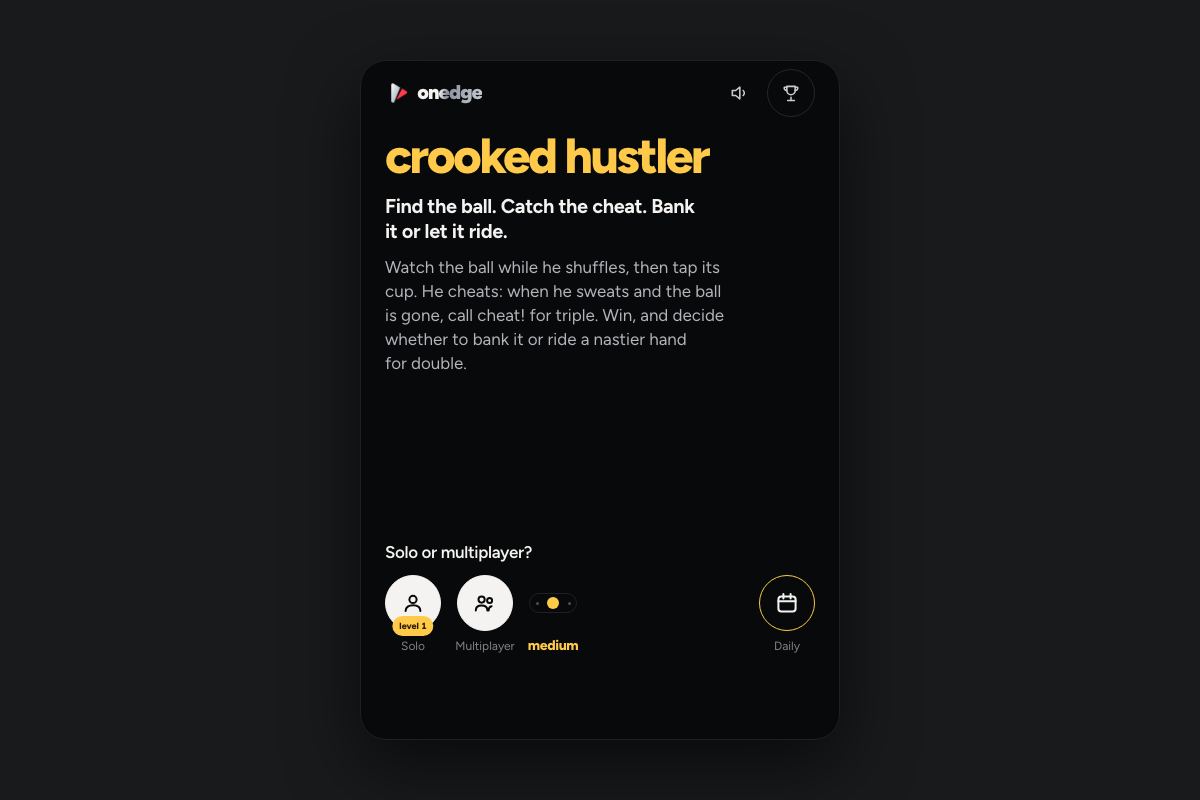 The start screen. The selector picks easy, medium or hard, and each difficulty keeps its own level, stars and daily night.
The loop of one hand
A night is ten hands, and each one goes the same way.
- The stake. About a fifth of your bank, rounded to the nearest 5, never under 10 and never more than you hold, leaves your bank and sits on the table as the pot.
- The show. He lifts the cup with the ball for a moment, then shuffles.
- The guess. When his hands stop, tap the cup you think hides the ball. Right doubles the pot. Wrong loses it.
- The decision. After a win you bank the pot or let it ride.
On a keyboard, press 1 to 4 for a cup (left to right), or use the left and right arrow keys and press Enter. C calls cheat, B banks, R lets it ride and P pauses.
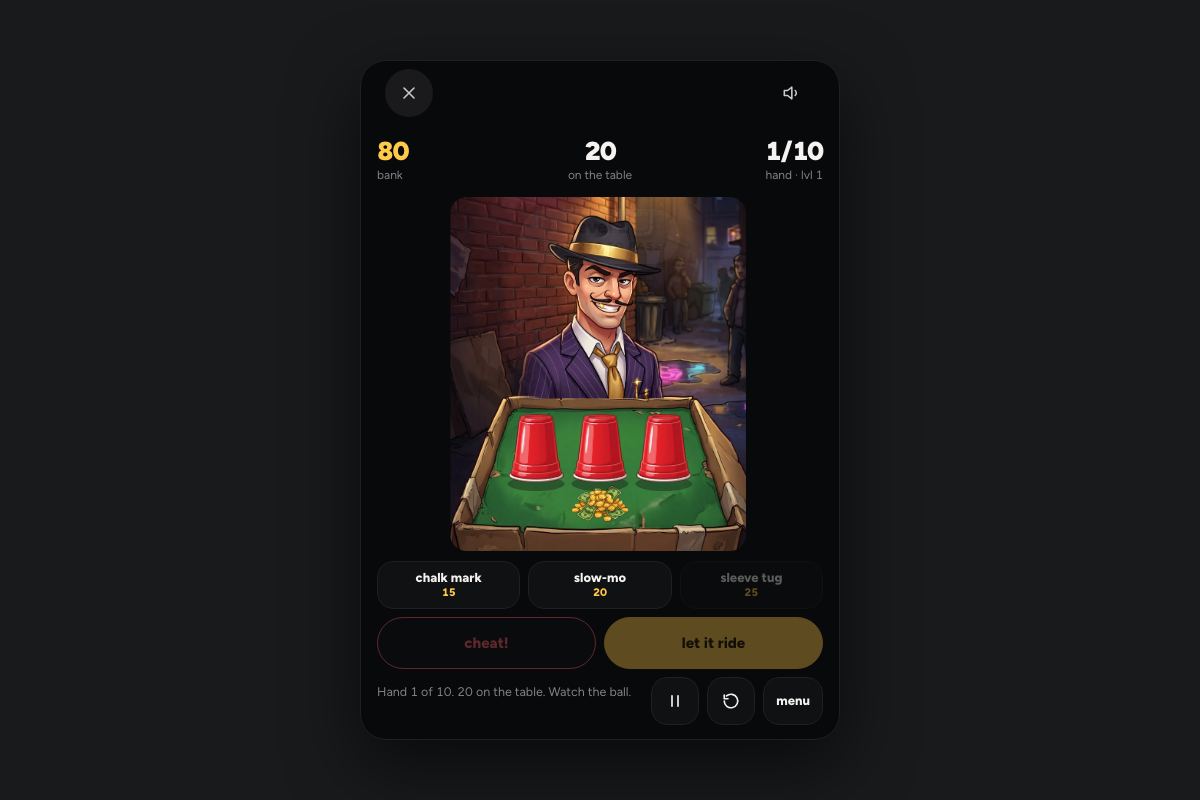 Bank 80 plus 20 on the table is a 100 start with the 20 stake already taken out. The sleeve tug is greyed because it can only be bought when it is time to guess.
The arithmetic of staking
Because the stake is a fifth of your bank, a found ball is worth about +20 percent of your bank and a missed one about -20 percent. Rounding the stake to 5 moves those numbers a little. Starting at 100 and banking every hand with no rides:
| Result over ten hands | Final bank |
|---|---|
| 10 wins | 620 |
| 9 wins, 1 loss | 410 to 425 (depending on when the loss comes) |
| 8 wins, 2 losses | 265 to 295 |
| 7 wins, 3 losses | 175 to 205 |
So, with no rides and no cheat calls, passing a level (250) takes at least eight of ten correct, and 500 for two stars needs a perfect ten of ten (620) or a catch. Catching a cheat is that help: it pays triple, so a stake of 20 becomes 60 instead of 40. A night of one catch, eight ordinary wins and one loss ends on 490 by the same rounding, with the catch first and the loss last.
How he cheats, and how to read it
He plays at most one dirty move per hand, and never in a hustle round. It is never the first move of the shuffle, and at least one ordinary swap always follows it. There are three kinds.
- The palm. His hand tips a cup, takes the ball and lifts away with it. No cup hides the ball, so any cup you tap loses. Press cheat! (or C) and you win triple.
- The plant. His hand picks the ball up and carries it sideways to a different cup. The ball is still on the table, so calling cheat here loses. Tap the cup his hand ended on.
- The wipe. Only possible if you chalked a cup. His hand scrubs the mark off and puts it on another cup. The ball never moved.
How the three are chosen: half of dirty moves are drawn as palms, about 27.5 percent as plants and about 22.5 percent as wipes. A wipe without a chalk mark to move is turned at random into a palm or a plant, so with no chalk on the table about 61 percent of dirty moves are palms and 39 percent plants. Chalking does not make him cheat more often, but it makes about a fifth of his tricks a trap for anyone who follows the mark instead of the cup.
The tell: he sweats for exactly as long as a dirty move lasts, and a dirty move runs at least twice as long as an ordinary swap and about a second or more on medium. When the face shows sweat and the hand is doing something other than swapping, stop following the cups and follow the hand.
How often, and when it starts
Whether a hand has a dirty move is a probability that grows with the hand. On level 1 the chance is 25 percent plus 4 percent per step along the curve, scaled by the difficulty and capped at 70 percent.
| Difficulty | First dirty hand | Chance at that hand | Chance at hand 9 |
|---|---|---|---|
| easy | hand 4 | about 26 percent | about 40 percent |
| medium | hand 3 | 37 percent | about 61 percent |
| hard | hand 1 | about 46 percent | 70 percent (cap reached by hand 6) |
Fake swaps, where two cups start to trade places and slide back, are an extra thing to watch from hand 8 on easy, hand 4 on medium and hand 1 on hard. About 18 percent of his shuffle moves become fakes once they start.
How the hands speed up
Everything is driven by one number, how far along the night this hand sits. It is the hand number, plus 2 for each time you have ridden on it, plus an offset for the difficulty (easy -1, medium 0, hard +2), plus 0.6 for each level above 1.
- Swaps per hand: 3 plus 1.15 times that number, rounded down, up to 16.
- Time per swap: 0.52 seconds minus 0.026 per step, never under 0.19, then scaled by the difficulty (1.18 easy, 1 medium, 0.86 hard).
- A fourth cup joins when the number reaches 7.
On medium level 1, hand 1 has 4 swaps at about half a second each and hand 9 has 13 swaps at about 0.29 seconds. A level is worth 0.6 of a hand, so five levels is three hands of difficulty. By level 5 a medium night already cheats on hand 1, and around level 11 it deals four cups from the start. Easy gets four cups at hand 8, medium at hand 7 and hard at hand 6 on level 1 (hard’s hand 5 is a hustle round with three cups).
Bank it or let it ride
After a win the pot sits on the table. Bank (the left button changes from cheat! to bank, or press B) puts it in your bank and deals the next hand. Let it ride (R) leaves the same pot out for another hand, which doesn’t advance the hand counter, and plays it as if it were two hands later in the night. You can ride three times in a row, and a win doubles the pot again, or triples it if you catch a palm. A loss takes everything in the pot.
For cup-only play, riding turns a pot of P into 2P with probability p and 0 otherwise, so it beats banking on average only when p is better than one half. If p is your chance of a correct cup pick and q your chance of a correct cheat call, counted as separate outcomes, compare 2p + 3q with 1 instead. These formulas assume the payout is below the 99,999-coin cap.
A blind cup pick succeeds at most one time in three with three cups or one in four with four; when the ball is palmed, no cup wins. Be most careful of the third ride, which plays at the equivalent of six hands further on. Three correct cup picks turn a pot of 40 into 80, 160 and 320. Correct cheat calls pay triple instead, but a single miss at any point leaves nothing.
Tricks
Tricks cost money from your bank and cannot be bought in a hustle round.
- Chalk mark (15). Buy it during the opening show or after a win, then tap a cup to put an X on it. The show lasts 2.6 seconds longer when a chalk mark is pending. A mark follows its cup through every swap. It lets a wipe happen.
- Slow-mo (20). His next four moves run at half speed, dirty moves included.
- Sleeve tug (25). Only when it is time to guess, once per hand. A bubble says “His sleeve is heavy!” if he palmed the ball or “His sleeve is empty.” if not. Heavy means call cheat. Empty means the ball is under a cup, so pick a cup.
The prices are flat while the stake grows with your bank. At the start of a night a 25-point tug costs more than the 20-point stake it protects, so it only earns its keep on a ridden pot or a larger bank. By a bank of 500 the stake is 100 and the same tug is cheap insurance.
The hustle round: you shuffle, he guesses
Hands 5 and 10 turn it around. The stake is the usual fifth of your bank. You see the ball for 1.9 seconds, then you have 6 seconds to swap cups: tap one cup, then another. If he picks the cup with the ball you lose the stake. If he picks any other cup, the stake doubles into your bank.
What goes on inside his head is simple enough to exploit. He holds a belief for each cup about where the ball is, and on every swap he either keeps the thread or loses it. If he loses it, the belief of the two swapped cups is averaged. So:
- A swap between two cups he believes are empty changes nothing. Only swaps that touch the ball cup, or a cup he is unsure about, can confuse him.
- Fast is what works. How likely he is to lose the thread on a swap depends on the gap since your previous swap and on the difficulty:
| Gap since your last swap | easy | medium | hard |
|---|---|---|---|
| under 0.35 seconds | 65 percent | 62 percent | 60 percent |
| 0.35 to 0.7 seconds | 41 percent | 35 percent | 31 percent |
| 0.7 seconds or more (and your first swap) | 19 percent | 12 percent | 6 percent |
One lost thread leaves him at 50/50 between the two cups, so a single fast swap is not enough. String several fast swaps through the ball cup. Each swap takes 0.26 seconds and a cup that is moving cannot be tapped, and with three cups every swap shares a cup with the one before, so the quickest you can go is a little over a quarter of a second. His face is your gauge: he looks smug when he is at least 75 percent sure of one cup and sweats when he is not.
Levels, stars and the endless board
Pass a night with 250 or more for one star, 500 for two and 1000 for three. Passing unlocks the next level, which is harder. Going broke ends the night early. A level cleared on easy, medium or hard is saved separately per difficulty, and the solo leaderboard ranks the level you reached on a difficulty, not your bank, with total stars as the tiebreak.
| Difficulty (level 1) | His hands | Cheating from | Fakes from | Fourth cup |
|---|---|---|---|---|
| easy | slow | hand 4 | hand 8 | hand 8 |
| medium | quick | hand 3 | hand 4 | hand 7 |
| hard | a blur | hand 1 | hand 1 | hand 6 |
The daily night
Once a day there is a night per difficulty, played at a fixed level 3. The first hands deal the same for everyone. Your score is the bank you hold after ten hands. Only the first night you finish on each difficulty counts, and leaving halfway does not use it up. Restart is disabled during the scored night. Later runs are labelled practice and are never submitted. The daily page has the rules for ties and what the seed shares.
Mistakes the numbers explain
- Calling cheat on a plant. The ball is still under a cup, so the call loses. If his hand dropped it in another cup, tap that cup.
- Following a chalk mark after a wipe. If the X jumps, the ball stayed put.
- Riding on a hunch. A cup-only strategy below one half loses on average; correct cheat calls change that threshold. Each ride plays two hands harder, often with a fourth cup. See the bank-or-ride comparison for the payout arithmetic.
- Swapping at an even pace in the hustle round. A gap of 0.7 seconds or more leaves him keeping the thread 81 to 94 percent of the time. Keep most gaps short.
- Swapping cups that do not matter. Swaps that miss the ball cup do nothing to his belief.
If you like this
filter is the other game here about reading an opponent’s tell: you ask about a face’s features and rule out what the answer eliminates. recall tests the other half of this one, remembering exactly what you saw a moment ago.
Written by the developer from the game's own code. Spot a mistake? hello@onedge.fun